
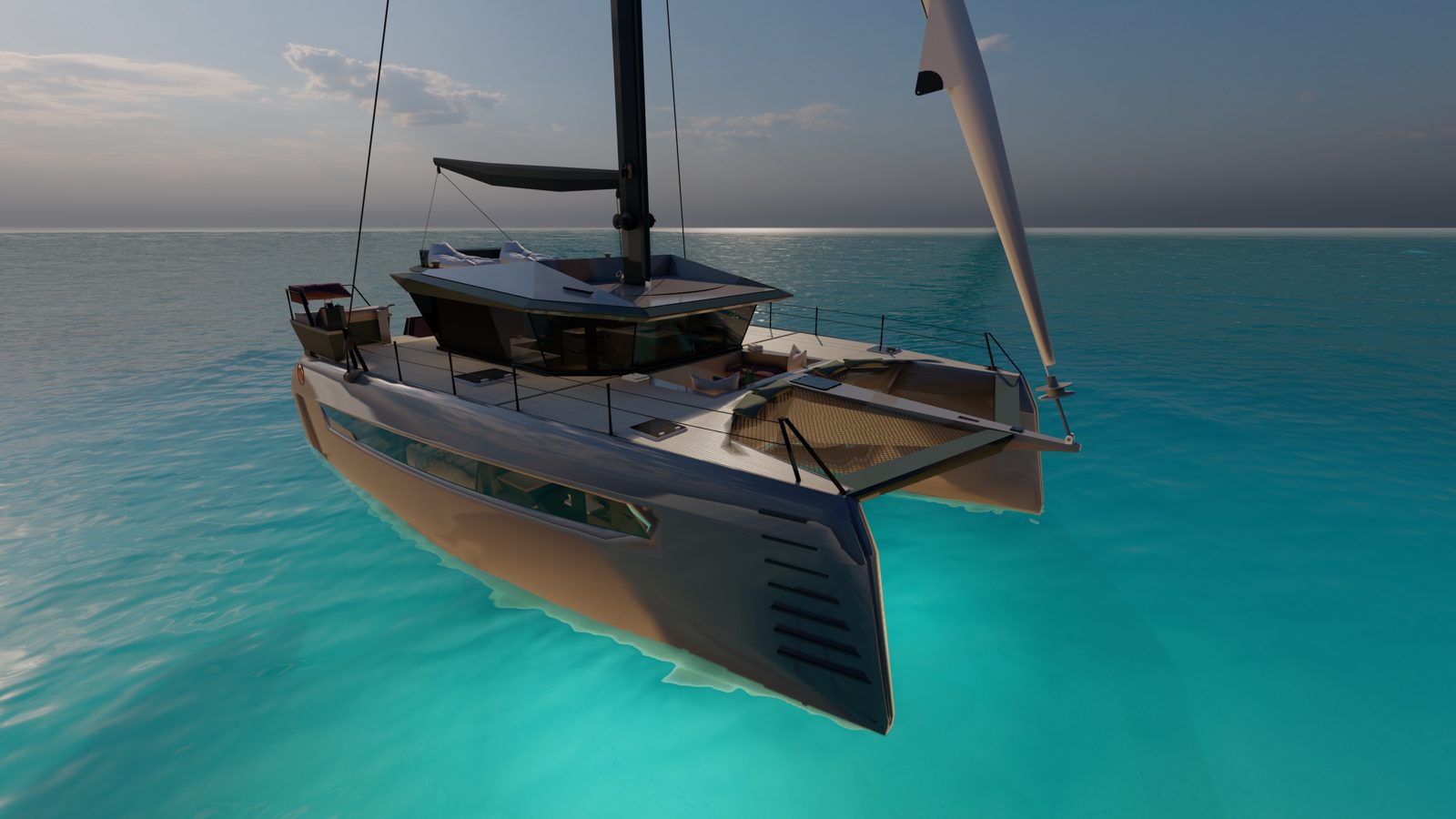

If you are looking at cruising catamarans and want a boat that one or two people can run without a crew, this page is a good place to start. It explains what the ONYX 10.5 is, the engineering choices behind it and how to see one for yourself.
What the ONYX 10.5 is
The ONYX 10.5 is a two-cabin cruising catamaran, designed and built by Onyx Marine in Kleinmond, in the Overstrand area of the Western Cape, South Africa. It is the only model we build. We designed it for couples, families and experienced sailors, and for people who want to go cruising without depending on extra hands.
The 10.5 in the name is the waterline length: 10.5 m (34.45 ft). Length overall is 10.7 m (35.1 ft) and the beam is 6.95 m (22.8 ft). That size is deliberate. A shorter boat is lighter and easier to handle, and it sits in what we call “the niche of more affordable catamarans”.
Designed to be sailed single-handed
Most of the decisions on the ONYX 10.5 start from one question: can one person manage this? We combine mechanical and electronic systems so that the boat can be sailed solo, and so that a couple can share the work without either of them being stretched.
In practice that means fewer things to look after and fewer jobs that need two people at once. The drive system, described below, is the clearest example.
One engine, two propellers, no gearboxes
The ONYX 10.5 has a single 42 hp Vetus diesel engine. Instead of driving each propeller through its own gearbox, the engine powers a hydraulic system, and that hydraulic system drives both propellers.
We chose this for three reasons:
- Less weight. One engine instead of two.
- Less maintenance. There are no gearboxes to service or repair.
- Useful power on board. The same hydraulic system can power optional extras such as air-conditioning and power generation.
We will cover the drive in more detail in a dedicated post on why we chose a hydraulic drive with no gearboxes.
Shallow draft and protected running gear
The ONYX 10.5 sits on two mini keels, which give it a shallow draft of 0.993 m. A shallow draft gives you more choice of where to anchor, and it makes routine jobs such as applying antifouling simpler.
Two skegs protect and carry the propellers and rudders, so the running gear sits behind solid structure rather than hanging exposed below the hulls.
The hulls are a sandwich construction: GRP (fibreglass) with a 20 mm core. The superstructure is GRP.
The rig
As standard, the ONYX 10.5 has an anodised aluminium mast with a mechanical flaking canoe boom and a minimum sail area of 64.66 m². A carbon fibre wing mast is available as an optional extra.
Stabilising winglets, as an option
Forward-mounted underwater stabilising winglets are available on the ONYX 10.5 as an optional extra. We will explain what they are and how they work in a separate post. We are not publishing performance figures for them here.
Living aboard: two cabins, two en-suites
The layout is built around two people living aboard for long periods, with room for family or guests.
- Two cabins, each with its own en-suite. Waterproof bulkhead doors give private access from the sugar scoops straight into the en-suite showers of each hull, so you can come in from a swim without walking through the saloon.
- A cooler, brighter saloon. The saloon windows slant forward in the classic way. That angle reduces reflected glare and keeps the saloon cooler in the sun.
- Electrics: a 24 V DC lithium house system, a 12 V starter system and a 230 V AC inverter.
- Tanks: 335 L of fuel, 500 L of fresh water and two 88 L black-water tanks.
Every boat is built to a written Standard Specification, which we will send you on request. If you want particular features added, tell us what you have in mind and we will check whether it is feasible for your build.
Built in South Africa, shipped worldwide
Onyx Marine was founded by Francois van Dyk and Chris Gooding, and every ONYX 10.5 is built at our factory in the Overstrand. A boat is in build there now.
Buying from South Africa does not limit where you sail. We work with logistics partners to ship the ONYX 10.5 by flat-rack or container, and reassembly support is available at the destination through certified marine technicians. A later post in this guide walks through shipping, reassembly and handover step by step.
Where to go next in this guide
This page is the starting point for our Cruising Catamaran Guide. Coming posts will go deeper into the points above:
- Why we chose a hydraulic drive with no gearboxes
- Stabilising winglets explained: what they are and how they work
- Designed for short-handed sailing: what makes a boat easier to handle
- Shallow-draft cruising and the places it opens up
- Buying a catamaran from South Africa: shipping, reassembly and handover
See the ONYX 10.5 for yourself
Specifications on a page only go so far. The best way to judge the ONYX 10.5 is to see how it is built and ask the people who build it.
- Book a factory walkthrough at our Kleinmond factory, or ask for a walkthrough by video call if you are overseas: Book a factory walkthrough
- Read the full features and specifications: ONYX 10.5 product information